


Smart Home Manufacturers in Switzerland: A Comparison of Hardware, Web Server Hubs, and Systems
Which smart home web server hub is right for which building? Learn what to look for when choosing a manufacturer, which technologies can be effectively combined, and why expandability, reliability, and durability are crucial.
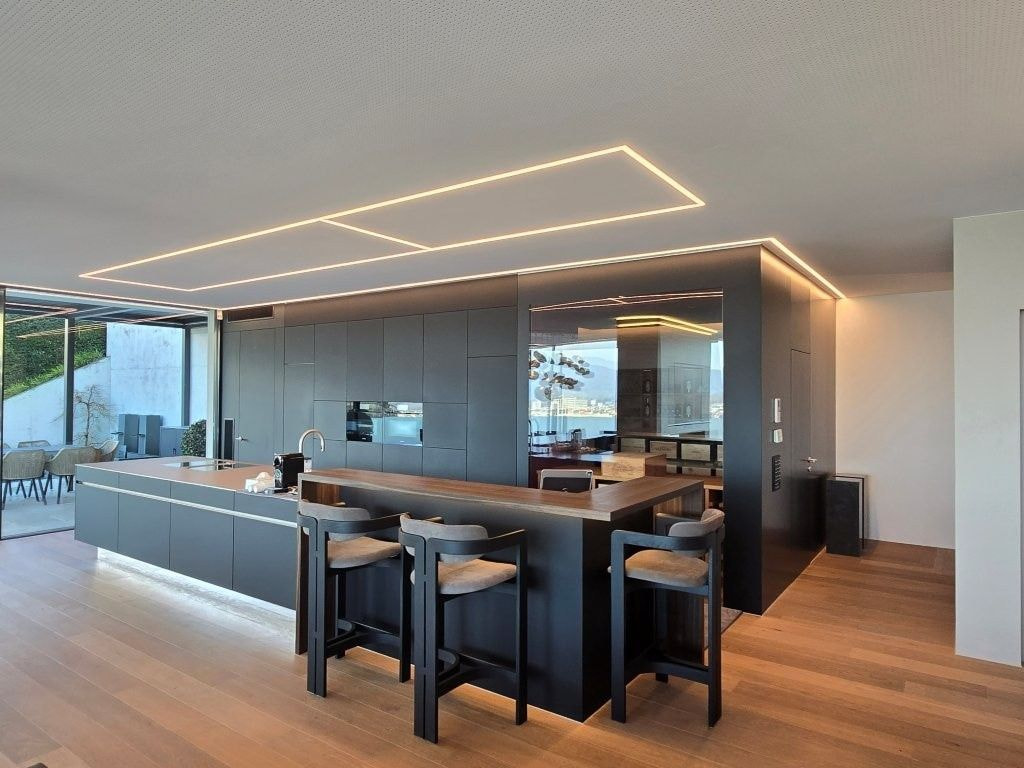
Smart Home Starts with Choosing the Right System
Lighting that automatically adjusts to the time of day. Blinds that respond to the sun’s position and the weather. A heating system that only uses energy in rooms that are actually in use. What should work seamlessly in everyday life requires a well-designed building automation system working behind the scenes.
Anyone exploring smart homes will encounter a wide range of manufacturers, devices, and communication standards. In addition to individual wireless components and app-based solutions, there are comprehensive building automation systems that integrate various functions.
The differences lie not only in price or the number of supported devices. What matters most is how reliably the individual components work together, which functions can be automated, and whether the system can still be expanded or modernized even after many years.
Especially for new construction and major renovations, it is therefore worth comparing not just individual products, but the entire system architecture.
What sets a good smart-home manufacturer apart?
A smart-home manufacturer develops hardware, software, or both to network and automate technical functions within a building.
The product range extends from smart light bulbs, outlets, and thermostats to professional control systems for entire buildings.
Three basic approaches can be distinguished here.
Closed Smart-Home Systems
Closed systems rely primarily on components from a specific manufacturer. Devices, software, and user interfaces are designed to work together seamlessly.
This often simplifies setup. At the same time, the selection of additional products may be limited. Anyone who wants to integrate new features later may be limited to the existing product lineup.
Open and Cross-Vendor Systems
Open systems use documented interfaces or standardized communication protocols to connect components from different manufacturers.
This offers more options when selecting devices and can make it easier to expand existing installations.
However, support for a communication standard does not automatically mean that all functions of a connected device are available. The specific implementation remains the decisive factor.
Modular building automation systems
Modular systems connect a central control architecture with various actuators, sensors, and gateways.
Depending on the project, individual functions can be added and additional building areas integrated without having to replace the entire installation.
This approach is particularly well-suited for buildings where long-term use, expandability, and coordinated control of various building systems are priorities.
A good system should not only meet today’s requirements; it should also align with the technical and economic expectations for the building’s entire service life.
Smart Home Hub: The Heart of Building Automation
The smart home control center is responsible for consolidating information from different areas of the building and deriving control commands from it.
For example, it processes signals from push buttons, occupancy sensors, temperature sensors, or weather stations and uses them to control lighting, shading, heating, or other technical systems.
Here’s an example illustrating the difference between a single control function and integrated building automation:
On a sunny summer day, solar radiation increases on the south-facing facade. The shading system automatically moves to an appropriate position to prevent the rooms from overheating. At the same time, the room temperature control system adjusts to the changing conditions.
Residents do not need to operate multiple devices or apps to achieve this. The functions work together within a coordinated system.
Local Control or the Cloud?
Many smart home products use cloud services for communication, remote control, or automation.
While this can simplify setup, it can also create dependencies on an internet connection and external services, depending on the architecture.
Professional building automation can perform key control functions locally. This is particularly important in situations where lighting, shading, or indoor climate control must function reliably even if the internet connection fails.
When selecting a system, you should therefore consider:
Which automation functions work without an internet connection?
Which functions require an external cloud service?
How are software updates and data security handled?
What options are available for remote access?
What happens if an external service is discontinued?
Local control and secure remote access are not mutually exclusive. What matters is how both functions are technically implemented.
Raspberry Pi or a professional building automation system?
A Raspberry Pi can be used as a platform for self-configured smart home solutions. With the right software, various devices and communication standards can be integrated.
For tech-savvy users, this can be an interesting option.
However, for building installations that operate continuously, additional requirements come into play: maintainability, documented system configuration, suitable hardware, long-term availability of replacement parts, and support from specialized service providers.
Professional building automation control centers are designed to meet these requirements. Together with actuators, sensors, and interfaces, they form a defined system architecture.
Which solution is appropriate therefore depends largely on whether individual devices are to be networked or whether the technical functions of an entire building are to be automated over the long term.
Which communication standards are important for building automation?
Modern building automation must be able to connect different technical functions. Communication standards and interfaces play an important role in this.
While technologies such as Matter, Thread, Zigbee, or Z-Wave are primarily used for connecting individual smart-home devices, comprehensive building automation solutions focus on different requirements.
These include the reliable control of lighting, shading, heating, cooling, and ventilation, as well as the integration of security systems and energy management.
In professional building automation, technologies such as KNX, DALI, EnOcean, Modbus, and DMX are used for this purpose. Systems like Casambi and Philips Hue can also be integrated into an overarching control concept via suitable interfaces.
The key is not to support as many communication standards as possible, but to reliably connect the technologies best suited to the specific building.
KNX – An Established Standard for Building Automation
KNX is a vendor-neutral standard for controlling various building functions.
It is used, among other things, for lighting, shading, room temperature control, and other automation tasks.
KNX offers a wide range of products from various manufacturers and is particularly common in professionally designed buildings.
However, planning, configuration, and integration depend on the chosen system architecture. Not every building requires the same level of technical complexity.
Therefore, for single-family homes, multi-family homes, and commercial buildings, it’s also worth comparing it with alternative building automation systems.
DALI – Intelligent Lighting Control
DALI stands for Digital Addressable Lighting Interface and is an established standard for digital lighting control.
Among other things, DALI enables the individual control of compatible lighting fixtures, the creation of lighting groups, and the implementation of various lighting scenes.
When combined with occupancy sensors and light sensors, lighting systems can be controlled according to need.
This is useful in residential buildings as well as in offices, schools, retail spaces, and other functional buildings.
EnOcean – Wireless Sensors and Control Elements
EnOcean is used, among other things, for wireless push buttons and sensors. Depending on the product, these can draw the energy they need from their surroundings and operate without batteries.
This offers advantages for retrofits or in situations where installing additional control wires would be extremely difficult.
Modbus, DMX, and Other Interfaces
Modbus is a widely used communication protocol employed, among other things, in technical systems and energy management.
DMX is used in particular for controlling more complex lighting systems.
In addition, there are other technologies such as Casambi and Philips Hue, each of which offers its own capabilities for lighting control.
For comprehensive building automation, it is crucial to determine which of these technologies can be integrated into a unified control system via suitable interfaces.
Comparing Smart Home Manufacturers: What Should You Look For?
When selecting a smart home manufacturer, it’s worth looking beyond the feature set of individual products.
1. Origin and development of the products
Does a manufacturer develop its own hardware and software, or does it primarily combine products from different vendors?
In-house development can offer advantages in terms of component integration, error analysis, and long-term product development.
The production location can also play a role, especially when short delivery times, technical support, and long-term product availability are important.
2. Expandability and System Architecture
A building changes over the course of its useful life.
Rooms are used differently, lighting concepts are adapted, or additional functions are integrated.
A modular building automation system can facilitate such changes.
In this context, it is important to assess not only whether additional devices can be connected, but also whether the existing control system offers sufficient capacity and suitable interfaces.
3. Replacement Parts and Long-Term Support
While smartphones and many consumer electronics devices are replaced after just a few years, a building’s technical infrastructure is designed for a significantly longer service life.
Therefore, the availability of replacement parts, the possibility of repair, and long-term, traceable system documentation are important decision-making criteria.
4. Operation and Visualization
A smart building should be easy to operate.
This includes traditional wall switches as well as clear visualization on a smartphone, tablet, or computer.
It is important that key functions can be operated even without a smartphone and that the user interface is tailored to the users’ actual needs.
5. Professional Planning and Installation
The quality of a building automation system does not depend solely on the products used.
Careful planning, proper installation, and transparent programming are equally crucial.
For larger projects, electrical planning, building automation, and the various trades involved should be coordinated early on.
Smart Building Automation: When Functions Work Together
The true benefit of a smart home system does not come from having as many connected devices as possible, but rather from the interaction of different functions.
Lighting Control for Comfort and Energy Efficiency
Intelligent lighting control enables customized lighting scenes.
In living areas, different lighting moods can be set up for everyday life, mealtimes, or relaxing evenings.
In offices, classrooms, and high-traffic areas, lighting systems can be combined with occupancy and brightness sensors.
This ensures that artificial light is used only when and to the extent that it is actually needed.
Automatic shading based on sun position and weather
A smart shading control system takes into account, for example, the sun’s position, brightness, wind, and other weather information.
The blinds can be automatically positioned to protect rooms from excessive sunlight without unnecessarily restricting available daylight.
In systems equipped accordingly, additional wind, rain, or hail protection functions can be integrated.
Control heating and cooling according to demand
A coordinated room temperature control system can take into account usage times, room temperatures, and other information.
In combination with shading, for example, solar heat gain can be influenced.
This improves thermal comfort and can help reduce energy demand for heating and cooling.
The actual savings achieved depend, among other factors, on the building envelope, the technical equipment, user behavior, and the selected control strategy.
Security and Central Building Functions
Security and comfort functions can also be integrated.
For example, when leaving the building, unnecessary lights can be turned off, defined shading positions can be set, and appropriate security functions can be activated.
Such workflows simplify operation and reduce the number of individual steps required.
TWILINE – Building Automation from Switzerland
For over 35 years, W. Wahli AG has been developing and manufacturing intelligent building automation systems in Switzerland under the TWILINE brand.
Unlike companies that merely supply devices, the company develops its own hardware and software, which work together within a modular system architecture.
TWILINE integrates various building functions into a coordinated automation system. These include lighting, shading, heating, cooling, ventilation, security, access control and intercom systems, multi-room audio, and energy management.
The system is suitable for single-family homes and apartments as well as for multi-family dwellings, office buildings, schools, and commercial properties.
The TWILINE Control Unit xBB-Z5-V
At the heart of the system is the TWILINE control unit xBB-Z5-V.
It handles central automation tasks and provides integrated web visualization.
Building functions can thus be controlled via smartphone, tablet, or computer. No separate visualization software is required.
The control unit can be connected to various technologies and system components via compatible gateways.
For larger installations, multiple control centers can be deployed. These enable a distributed system architecture in which individual areas operate semi-autonomously.
Integrating Different Technologies Effectively
TWILINE is not limited to a single type of control element or a single communication standard.
Using appropriate gateways and interfaces, technologies such as DALI, EnOcean, Modbus, KNX, DMX, Casambi, and Philips Hue can be integrated into suitable control concepts.
This allows different technologies to be used during planning wherever they make technical and economic sense. Existing installations can also be integrated into a higher-level building automation system, depending on the available components and interfaces.
The specific integration depends on the components used and the available interfaces.
Modular Technology for Long-Term Use
An important part of the TWILINE philosophy is the longevity of its products.
W. Wahli AG relies on in-house developments, modular systems, and a long-term spare parts supply of over 15 years.
This allows existing systems to be operated over extended periods and expanded in a targeted manner as requirements change.
This is a key factor in protecting your investment, particularly for buildings with a service life spanning several decades.
TWILINE in Practice: From Residential Homes to Universities
Exclusive Villa – Smart Living with TWILINE
An exclusive villa, in which all essential building functions have been automated with TWILINE, demonstrates how sophisticated architecture and smart home technology can be seamlessly integrated.
Generous window facades, natural materials, and a carefully coordinated lighting concept define the building. Behind the scenes, a comprehensive TWILINE smart-home solution intelligently integrates lighting, shading, heating, and cooling.
Custom lighting scenes create different atmospheres in the living and sleeping areas. The automatic shading system takes sunlight into account and works in conjunction with the room temperature control to maintain a comfortable indoor climate.
The office, wine cellar, gym, and outdoor areas are also integrated into the building automation system. This includes the lighting for the pergola as well as the coordinated outdoor lighting.
The various functions can be conveniently controlled and operate largely automatically in everyday life.
What makes this smart-home installation unique is the interplay of architecture, lighting design, and intelligent building technology. The automation operates in the background, while residents enjoy a high level of living comfort and ease of use.
University of Zurich (UZH) Library
The University of Zurich Library utilizes 17 TWILINE control units with over 4,000 data points.
The installation demonstrates how extensive automation tasks can be implemented within a distributed system architecture.
Gässliacker Foundation
At the Gässliacker Foundation, more than 400 venetian blinds and 1,100 DALI components, among other things, are automated via TWILINE.
Multiple control units and weather stations ensure that the various building functions can be coordinated.
Chris Sport, Eschlikon
TWILINE is also used in commercial buildings.
At Chris Sport in Eschlikon, the installation includes, among other things, more than 1,500 DALI components and over 100 occupancy sensors.
These examples show that the technology is not limited to individual apartments or single-family homes, but can also handle large-scale building installations.
Smart Home in New Construction or Renovation?
Whether it’s a new construction or a renovation: The requirements for building automation vary depending on the initial situation.
New Construction: Coordinate Functions Early On
In a new construction project, electrical installations, building automation, and technical systems can be planned together from the very beginning.
This simplifies the coordination of wiring, distribution, sensors, and control functions.
If lighting, shading, and indoor climate are considered early on, the desired automation features can be systematically implemented.
Renovation: Reusing Existing Systems
In a renovation project, part of the technical infrastructure is often already in place.
In such cases, it’s worth assessing which components can be reused and where new interfaces or control devices are needed.
Wireless push buttons and sensors can offer additional options if running new wiring would be too costly or time-consuming.
The appropriate solution depends on the condition of the existing installation and the desired functions.
Smart Home and KNX: Which Solution Is a Better Fit?
KNX is an established standard for professional building automation and offers a wide selection of compatible products from various manufacturers.
For many projects, this provides a suitable technical foundation.
However, not every building requires the same system architecture.
Especially for single-family homes, multi-family homes, or commercial buildings, it’s worth considering whether a comprehensive KNX installation is necessary or whether a modular building automation system can meet the requirements just as well—or even better.
TWILINE offers an alternative here with its own control architecture, integrated web visualization, and various interfaces. KNX push-buttons can also be integrated into the TWILINE system.
Which solution makes more sense from a technical and economic standpoint depends on the requirements of the specific project. Key factors include the desired range of functions, the building structure, existing installations, and the potential for future expansions.
Checklist: How to Find the Right Smart Home Manufacturer
Before deciding on a smart home system, you should clarify a few basic questions.
Which building functions should be automated? Just lighting and shading, or also heating, cooling, ventilation, and energy management?
How large is the building? An apartment has different requirements than a multi-family home or an office building.
What technologies are already in place? Existing installations and communication standards should be taken into account.
Which functions must be available locally? In particular, important automation features should not rely unnecessarily on external services.
How should the building be controlled? Via wall switches, a smartphone, a tablet, a computer, or a combination of these?
How important are expandability and the availability of replacement parts? A long-term perspective can reduce future costs and the need for unnecessary material replacements.
Who will handle planning, installation, and support? Professional implementation is just as important for long-term operation as product selection.
Answering these questions early on lays a solid foundation for reliable and cost-effective building automation.
Frequently Asked Questions About Smart Home Manufacturers and Control Centers
Which smart home manufacturers are active in Switzerland?
Both international providers and Swiss companies that develop their own products for smart homes and building automation operate in Switzerland.
W. Wahli AG, with its TWILINE product line, is one of the Swiss manufacturers that develops and produces its own hardware and software for intelligent building control.
What is the difference between smart homes and building automation?
“Smart home” often refers to the intelligent networking and control of technical functions in residential settings.
Building automation is the broader term and also includes larger residential buildings, office properties, schools, and other functional buildings.
The technical fundamentals overlap. Differences arise primarily from the scope of functions, the system architecture, and the operational and maintenance requirements.
Does every smart home need a central control unit?
Not necessarily. Some individual devices can be operated directly via an app or a cloud service.
However, if various functions are to be linked together and more complex automations are to be implemented, a centralized or coordinated control architecture offers significant advantages.
Can a smart home function without the internet?
Yes. With the right systems, key automations can be executed locally.
Whether a specific function is available without the internet, however, depends on the hardware, software, and system configuration used.
Is TWILINE an alternative to KNX?
Yes. TWILINE offers a standalone building automation solution with a modular architecture, integrated visualization, and various interfaces.
KNX push buttons can also be used via appropriate integration.
Which solution is more suitable depends on the requirements of the specific project.
Can different smart home systems be connected to each other?
In principle, yes, provided that suitable interfaces, gateways, or communication protocols are available.
The actual possibilities depend on the products used and the supported features.
How long should a smart-home system remain usable?
For permanently installed building automation systems, long-term use should be taken into account during the planning phase.
In addition to the technical lifespan, the availability of replacement parts, software maintenance, documentation, and future expansion options are crucial.
Can smart building automation save energy?
Yes. For example, demand-based lighting, automatic shading, and coordinated heating and cooling control can help reduce energy consumption.
The actual savings depend on the building’s structural conditions, the technical design, and how the building is used.
Conclusion: It’s not the number of smart devices that matters, but how they work together
A smart building isn’t created simply by connecting as many devices as possible.
What matters is that lighting, shading, indoor climate, and other functions work together reliably and are easy to operate.
When selecting a smart-home manufacturer, therefore, one should not consider only the purchase price and current product features. Equally important are a well-thought-out system architecture, long-term expandability, spare parts availability, and professional implementation.
With TWILINE, W. Wahli AG has been developing and manufacturing building automation systems in Switzerland for over 35 years. From individual apartments to large-scale functional buildings, we create solutions that integrate various technologies and are tailored to the building’s specific requirements.
Are you planning a new construction, a renovation, or looking to expand an existing building automation system?
Discover the possibilities of TWILINE and let us advise you on which solution is right for your project.
TWILINE – Intelligence for Buildings.